Ultrasonic Cleaner Solutions for Every Use
Select your solution formulation by using this table to match what you are cleaning with the suggested cleaner for ultrasonic. Containers are shipped with use instructions.
If you still have questions about which cleaner for ultrasonic to use for your cleaning needs and ultrasonic cleaner, chat with us to get answers from our experts.
| PRODUCT NAME | PARTS TO CLEAN: | FOR REMOVAL OF: | DILUTE TO: |
| Elma tec clean A4 |
Engine parts, all metals, glass, ceramics, plastics, rubber | Oil, grease, combustion residues, soot, dust, other organic contamination | 2-5% |
| Elma tec clean A1 |
Electronics, PCBs, electromechanical components, fine optics | Flux residues, polishing suspensions, grease, oil, dust, fingerprints | 3-10% |
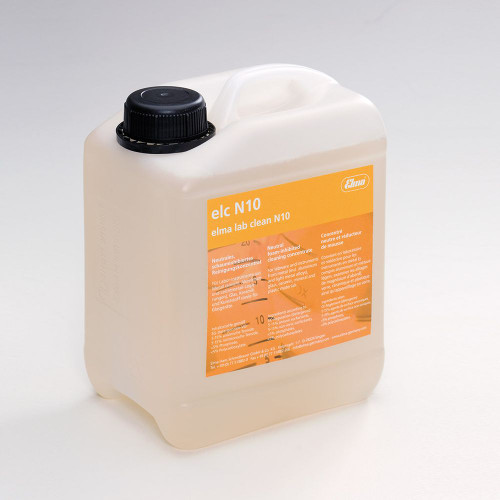
| Elma Lab Clean N10 | Delicate instruments & labware of metals, light metals, glass, ceramics, plastics | Emulsions, residues of markings & labels, lime soaps, light greases & oils, fingerprints & dust | 1-2% |
| Elma tec clean S1 |
Non-ferrous & light metals, PCBs, stainless steel, glass, plastics | Mineral deposits, oxide layers, rust & lime; polishing media, mineral grease, oil | 1-5% |
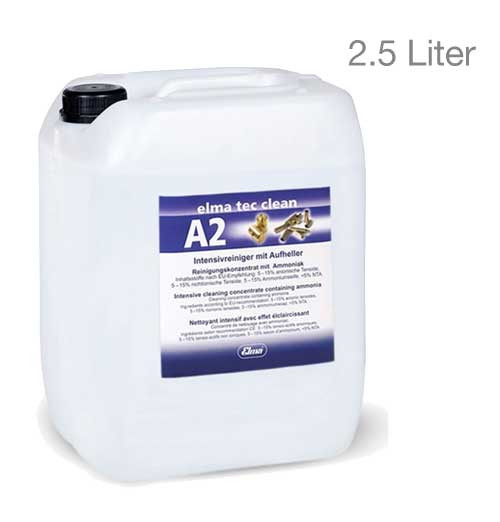
| Elma tec clean
A2 |
Ferrous & non-ferrous metals, precious metals, glass; brighten brass & copper | Oil, fat, grease, sweat, oxides, buffing compounds | 3-5% |
| Elma tec clean
N1 |
Gentle Cleaning of Metals, Plastics, Ceramics, Glass, Rubber, & Jewelry | Oils, Greases, Grinding, Lapping & Polishing Residues, Dust, Fingerprints | 5% |
| CLN-SC75 | Spray gun parts and tools, brass, stainless steel. | Polyurea, polyurethane, epoxies, resins, water- or oil-based paints. | 50% to Full Strength |
| JewelryClean
S8 |
Silver, Platinum, Jewelry and Gems | Dirts, Grease, Buffing compounds, Rouge, Tripoli, Oxides | 2-5% |
| Elma clean
260 (ec 260 d&s) |
Aluminum, laser machined parts, light metal alloys; glassy, ceramic and mineral surfaces, plastics | Aqueous cooling emulsions, greases, oils, fingerprints, dust, lime soaps | 2% |
| Mold Release | Steel molds, injection molding tools | Burnt-on plastic and rubber | 50% to Full Strength |
| Elma tec clean KS | Steel, gray cast iron and hard metals. | Prevents corrosion of metals during/after aqueous cleaning. | 0.05 - 0.5% |
| Shellac Buster |
Heavily soiled carburetors and engine parts, production equipment, tools, mixing vats, tanks and drums | Carbon, varnish, shellac, rust, printing inks, paints, adhesives, powder coatings, grease and oil | Full Strength |
| GunClean
L6 |
Guns, rifles, aluminum parts | Carbon, Oil, Grease, Dirt | 10% |
| GunLube
L5 |
Lubricates guns, rifles, bicycle parts | Full Strength | |
| Hydro-Sonic Non-ammoniated | Heavily soiled metal parts, printing plates | Ink, dyes, grease, heavy soils, varnish | Makes 8 gallons of solution per bottle |
| Medclean
C7 |
Medical and Dental Instruments | Blood, Tissue, Ointments, Bodily Excretions | 1-3% |
Ultrasonic Cleaning Solutions and Applications
Just as selecting the correct ultrasonic cleaner equipment is critical to a satisfactory cleaning operation, so too is selecting the correct ultrasonic cleaning solution.
Equipment and ultrasonic cleaning solution decisions can be made in parallel with the knowledge that the ultrasonic cleaner you use does not restrict the ultrasonic cleaning liquid you use*. The choices are based on what you are cleaning and the type of contaminants being removed.
(If you are unfamiliar with the process, check how ultrasonic cleaning works.)
Types of Ultrasonic Cleaning Solutions
Most ultrasonic cleaning solutions (also called soaps, chemicals, and detergents) in use today are in the form of water-based biodegradable concentrates—although some may be used full strength. These formulations are a far cry from chemistries used in the past that posed health and challenging disposal concerns.
In general, modern ultrasonic cleaner liquids can be broadly classified by pH or as emulsifying or demulsifying formulas.
- Classification by pH (Acidity/Alkalinity)
The pH designation helps classify the formula as acidic, alkaline, or neutral, with high pH values associated with alkaline and lower values as acidic. - Alkaline Solution (pH >7) such as Elma tec clean A4, a demulsifying cleaning solution widely used to remove oil, grease, soot, coking, forge dust, and fingerprints.
- Acidic Solution (pH <7) such as Elma tec clean S1, a demulsifying cleaner used to remove rust, lime, oxide films, grease, and oil from nonferrous metals.
- Neutral Solution (pH ≈7) such as Elma Lab Clean N10, a demulsifying formulation that can be used safely for metals, plastics, ceramics, glass, and rubber.
- Classification by Contaminant Handling
- Emulsifying Formulations This type of ultrasonic cleaner solution keeps oily contaminants in suspension where they accumulate and begin to lower cleaning effectiveness over time. These formulations are typically used for low-volume cleaning operations.
- Demulsifying Formulations These ultrasonic cleaner liquids allow oily contaminants to float to the surface where they can be skimmed off and set aside for later disposal. This prolongs the effective life of the solution and is often preferred for high-volume or continuous operations.
Note that for both formulations hard contaminants fall to the bottom of the tank and must be removed when spent cleaning solutions are replaced.
Optimizing Ultrasonic Cleaner Solution Use
Manufacturers provide detailed instructions on the ultrasonic cleaner solution use. Here are some examples:
- Dilution. Always follow the manufacturer's specified dilution recommendation (such as diluting to 5 to 10 percent with water) for optimal cleaning performance and cost-effectiveness.
- Degassing. Fresh cleaning solutions contain trapped air that inhibits the cleaning action. Remove it by activating your unit’s degas or dynamic mode (if so equipped). Otherwise operate the unit without a load until air bubbles no longer come to the surface.
- Temperature. Using the liquid at the specified temperature is crucial as it enhances the cleaning power of the solution and the efficiency of cavitation. Ultrasonic cleaners equipped with heaters shorten times needed to bring solutions to the recommended temperature.
- Safety Precaution (Acids). If strongly acidic solutions are used, the stainless-steel tank must be protected by using an acid-resistant tub insert sized for the unit you are using. The tank should contain tap water and a surfactant such as a few drops of liquid dishwashing detergent. Ultrasonic energy passes through the insert walls to act on parts.
- Safety Documentation. Safety Data Sheets (SDS) detail the chemistry, safe handling, and proper disposal procedures for the ultrasonic cleaner solution.
- Economy. As noted above contaminants removed during cleaning remain the solution or fall to the bottom of the cleaning tank. To get the most out of your cleaning solution investment see our tips on Extending Cleaning Solution Performance.
Some Closing Remarks on Ultrasonic Cleaner Solutions
We hope this information proves helpful as you navigate the many ultrasonic cleaning solution formulas listed below.
Additional suggestions will be found in "How to Select an Ultrasonic Cleaner Solution.” And you can always connect with the professionals at iUltrasonic if you need additional information.
*An exception applies if you clean with volatile or flammable solvents.